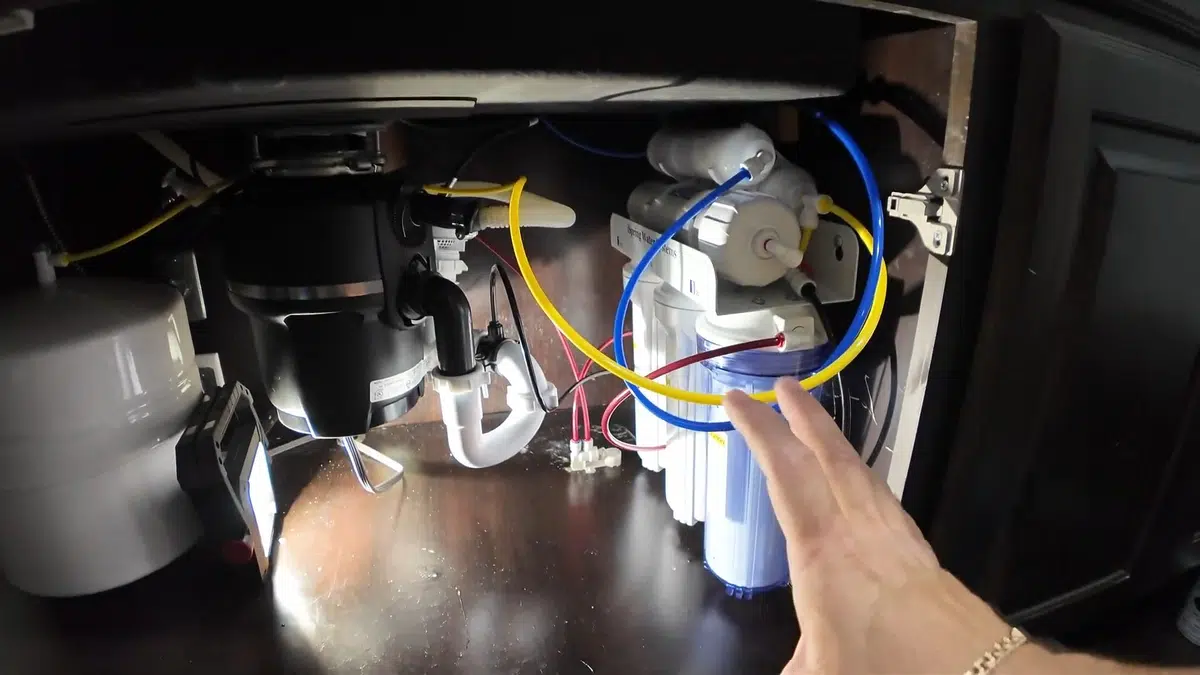
Golden State Water's West OC supply: what is in the water
Golden State Water Company's West Orange County system blends OC groundwater basin water with imported water from the Metropolitan Water District's Colorado River and Northern California sources. The blend ratio shifts seasonally: when OC groundwater is the dominant source, the water runs harder (250 to 300 ppm). When MWD imports increase, the hardness drops somewhat (180 to 230 ppm). The practical result is that Stanton's water is always in the moderately hard range, just with some seasonal variation in exactly how hard.
Golden State Water publishes hardness data in its annual Consumer Confidence Report, which is available on the utility's website. The report lists total dissolved solids and specific ion concentrations for each service area. For Stanton, the numbers have consistently shown hardness in the range that produces visible scale accumulation in fixtures within months of installation and significant sediment in water heater tanks within the first few years of service.
How hard water affects each part of your Stanton plumbing system
Water heaters
Hard water's most damaging effect on tank water heaters is sediment accumulation on the tank floor. Calcium and magnesium carbonate precipitate when the cold supply water is heated, settling to the bottom of the tank. Over years without maintenance, this sediment forms a thick insulating layer above the burner that forces the burner to run longer cycles at higher temperature to heat the water above it. The additional heat stress on the tank steel above the sediment is a primary cause of tank failure in OC water heater replacements. Annual sediment flushing removes this accumulation before it becomes a failure driver.
Faucet cartridges and aerators
Faucet cartridges in hard water areas wear faster than in soft water areas because calcium deposits accumulate on the cartridge's internal seating surfaces. A thermostatic or pressure-balancing shower cartridge that would last 8 to 12 years in a soft water area may need replacement in 4 to 7 years in Stanton's hard water environment. Aerators (the small screens at faucet outlets) accumulate scale that restricts flow and should be soaked in vinegar and cleaned every 6 to 12 months as basic maintenance.
Copper hot water supply lines
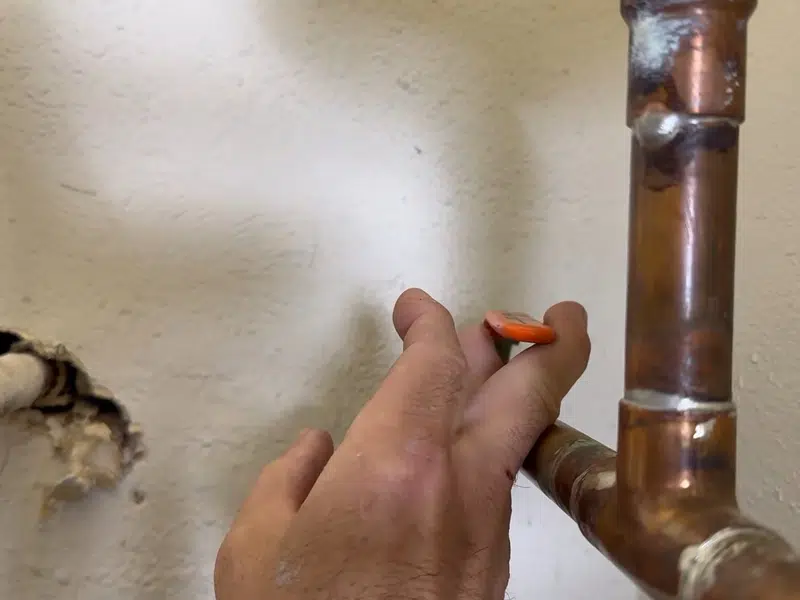
The most consequential long-term hard water effect on Stanton's plumbing is the accelerated pitting corrosion of copper hot water supply lines. Mineral content in the water reacts with the copper surface at elevated temperatures, creating microscopic pits that over 50 to 60 years of continuous exposure become through-wall pinholes. This is the root cause of central OC's slab leak pattern in 1960s-70s slab foundation homes with copper supply. Homes on softened water experience this failure mode at a significantly slower rate.
Tankless water heater heat exchangers
Tankless heaters do not accumulate sediment in a tank, but scale builds up inside the narrow passages of the heat exchanger where water is heated rapidly. This scale acts as an insulator, reducing heat transfer efficiency and eventually causing the unit to overheat or develop flow blockages. Annual or biennial descaling is the standard maintenance for tankless heaters in Stanton's hard water environment.
Solutions for hard water effects in Stanton homes
A whole-house water softener addresses all of the above issues by removing hardness minerals before the water reaches any fixture, appliance, or supply line in the home. Ion exchange softeners exchange calcium and magnesium for sodium, producing soft water that does not cause scale, does not accelerate cartridge wear, and does not pit copper supply lines. For Stanton homeowners who are dealing with frequent water heater maintenance, recurring aerator clogs, or a pattern of plumbing failures that suggests system-wide hard water effects, a softener is the most effective long-term solution.
For homeowners who want better-tasting drinking and cooking water in addition to addressing scale, pairing a whole-house softener with an under-sink reverse osmosis system at the kitchen tap is a common approach. The RO system removes most of the sodium added by the softener along with other dissolved solids, producing high-purity water at the kitchen faucet while the softener protects the rest of the home's plumbing.
Related plumbing resources
Services: Water Softener Installation, Water Filtration Installation, and Water Heater Repair
Service areas: Cypress CA, Los Alamitos CA, and La Palma CA
Related articles: How Long Do Water Heaters Last in OC? and Water Heater Replacement Cost in Stanton
Frequently asked questions
Golden State Water Company's West OC supply, which serves Stanton, Cypress, Los Alamitos, La Palma, and parts of other central OC cities, runs in the 200 to 300 ppm range (approximately 12 to 18 grains per gallon) depending on the season and the ratio of OC groundwater to Metropolitan Water District imported water in the blend. This falls in the moderately hard to hard range on the EPA's classification scale. Golden State Water publishes an annual Consumer Confidence Report that includes current hardness data for their service areas.
Yes. In hot water copper supply lines, the calcium and magnesium minerals in hard water precipitate out of solution at the elevated temperature and deposit on the interior pipe surface. Over decades, this creates a scale layer that acts as an insulator and can also cause localized pitting at areas of turbulence or at the interior pipe wall where pH is slightly different. Central OC slab leaks in copper hot water lines are accelerated by the hard water environment compared to what would be expected in soft water areas.
A water softener uses ion exchange to replace calcium and magnesium hardness minerals with sodium, which eliminates the scale problem entirely throughout the home. A water filter (such as a whole-house carbon filter or an under-sink reverse osmosis system) removes specific contaminants but does not address hardness minerals unless it includes a softening stage. For the scale and pipe protection benefits, a water softener is the appropriate solution. For improved taste and reduction of other dissolved solids, an RO system under the kitchen sink addresses those separately.
All cities on Golden State Water Company's West OC system share the same supply characteristics: Stanton, Cypress, Los Alamitos, La Palma, Seal Beach, and portions of Huntington Beach and other neighboring communities. Homeowners in any of these cities experience the same scale accumulation in water heaters, the same aerator and showerhead clogging, and the same accelerated copper corrosion in hot water supply lines as Stanton residents.
Get help from a licensed Stanton plumber
Serving Stanton and central OC with same-day service and 24/7 emergency dispatch.